A Winter Evening Built Around a Read-Aloud
A winter evening read-aloud can bring people together without demanding constant attention: choose short texts, share turns gently and leave room for pauses.
The common mistake with a winter evening read-aloud is treating it like a performance: one person reads a long piece while everyone else is expected to sit still and listen. The cost is a roomful of people who feel they must keep up, even when they are tired or their attention wanders. A better plan makes the reading one option within the hour, not a test of concentration.
Imagine that Maya invites her brother, her neighbour Jo and two friends to her flat on a cold evening. They have different reading habits: one enjoys poetry, another loses the thread in long passages, and one would rather listen than read aloud. Maya’s aim is not to finish a book. She wants the group to share a calm stretch of the evening, with enough structure to get started and enough freedom for people to drift in and out.
How can a winter evening read-aloud stay low-pressure?
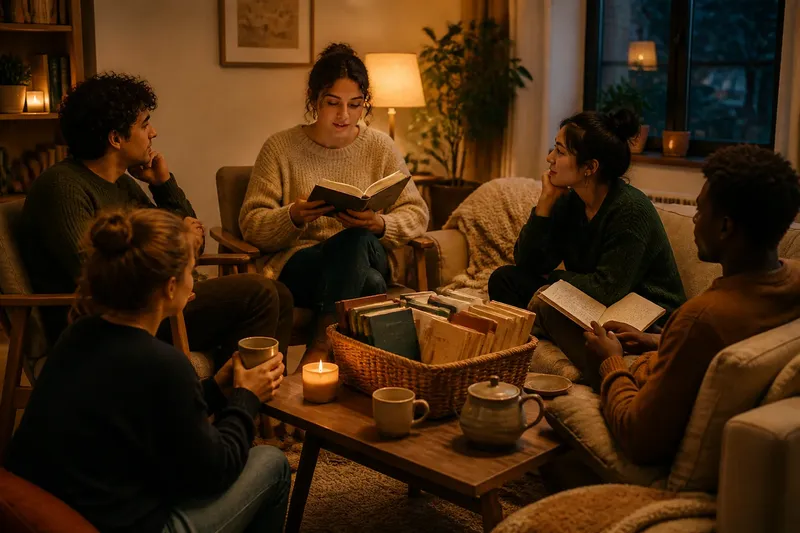
Maya chooses a simple centre for the gathering: a basket of short, self-contained texts, with no single selection treated as the main event. She tells the guests that they can read, listen, make tea, look through the texts or take a quiet break. Nobody needs to explain a change of attention.
That invitation matters because the plan is social before it is literary. A read-aloud can hold a group’s attention for a while, but it need not hold every person’s attention every minute. If someone misses a paragraph, there is no need to rewind the whole evening. The next text can begin when the room is ready.
Maya keeps the first gathering modest. She sets out a few chairs at different angles rather than arranging everyone in a rigid circle, leaves a clear route to the kitchen, and puts the texts within easy reach. A lamp makes the pages comfortable to read, while the rest of the room remains usable for people who want to sit back or move around.
Keep the invitation easy to accept: “We’ll read a few short things after tea; join in as you like.”
What should Maya put in the reading basket?
The best choices are short enough to finish without demanding a large block of attention, and varied enough that the group can change direction. Maya avoids assembling a sequence that requires everyone to remember a cast of characters or follow one argument across many pages. Instead, she gathers pieces that can stand on their own.
- A short poem: Choose one that can be heard as well as read silently, and leave a little space afterwards before discussing it.
- A brief personal essay: A compact piece about an ordinary subject can prompt conversation without needing specialist knowledge.
- A folk tale or traditional story: A complete narrative gives listeners a clear beginning and ending, even if they arrive partway through the evening.
- A page from a familiar book: A passage people already know can be comforting, provided the group is happy not to follow the whole plot.
- A short letter or diary entry from a public-domain collection: Its direct voice can make a change from poetry or fiction.
- A text someone brings along: Let the reader explain why they chose it, but keep the introduction brief and optional.
She makes room for different kinds of writing, but not so much material that the basket starts to feel like homework. The guests can select a piece by browsing, or Maya can offer two choices when the group is ready for another reading.
If the text is from a book, Maya checks that it is suitable to read aloud and easy to follow without a long preface. She also avoids asking a guest to read a passage they have not seen first; a quiet moment to scan the page gives them a genuine choice.
Keep the pieces complete and short; the room can choose what comes next.
How should the group share the reading?
Maya begins by reading the first piece herself. That gives everyone time to settle and shows the intended pace: unhurried, clear and without theatrical pressure. Afterward, she asks whether anyone would like to choose the next text. She does not go round the room insisting that each guest take a turn.
For some groups, a gentle invitation is enough: “Would you like to read this, or shall I?” For others, passing a text to the next person works well, as long as passing is just as acceptable as reading. A turn should be offered, not assigned.
When someone does read, the group can let them choose how much. One person may prefer a whole poem; another may be comfortable with a paragraph. A listener can also ask the reader to stop at the end of a page or section. This keeps the reading shared without making every voice responsible for carrying the whole gathering.
Say you are hosting a small group in which one guest enjoys reading and another is unsure about doing it aloud. You could offer the keen reader a short story, then ask the hesitant guest whether they would prefer to choose a poem for you to read. The expected result is a shared choice without putting the quieter guest on the spot.
Maya also gives the group permission to respond in different ways. One person might mention a striking phrase; another might simply say they liked the sound of it. Silence can be a complete response. Discussion is welcome when it arises, but no one has to explain what a text means to them.
When should the room pause?
Pauses are part of the shape of the evening, not an interruption to overcome. Maya leaves a moment after a reading before asking what anyone thinks. That space allows listeners to finish absorbing the words, and it prevents conversation from turning into an immediate round of opinions.
She also watches for ordinary signs that the group needs a change: someone getting up for a drink, a conversation starting at the edge of the room, or several people looking away from the pages. These are not failures. They can be cues to stop, stretch, refill mugs or switch from reading to quiet browsing.
Rather than scheduling a strict break, Maya makes one easy to take. The kettle is available, the basket stays on the table, and no one has to wait for a formal interval to move. If the group returns to a text, they can pick up with a new piece instead of trying to recover a place in a longer work.
A pause can also be a change of mode. Someone might read silently for a few minutes, or the group might talk about a passage without choosing another one straight away. The point is to let attention settle, not to fill every gap with fresh material.
What if people want different levels of attention?
That is the situation Maya plans for, rather than a problem she tries to remove. One guest may listen closely throughout; another may dip in for a poem and then look through a magazine; a third may leave the room briefly. The gathering can still feel shared if people know they are welcome to return without asking permission.
Maya keeps the social centre of the evening clear but flexible. She does not run two simultaneous readings, which could make the room difficult to follow. Instead, the main voice pauses when conversation begins, and the group decides naturally whether to talk, continue reading or take a break.
For a listener who finds it hard to follow spoken text, Maya offers a printed copy to read along with. For someone who prefers not to see the page, she reads at a steady pace and identifies the title before starting. These small choices make participation easier without turning the gathering into a lesson or requiring anyone to disclose why they prefer one way of listening.
It helps to keep the evening’s expectations visible in the host’s behaviour. Maya does not monitor who has been paying attention, quiz the guests afterwards or insist that everyone comment. She treats a person’s quiet presence as participation.
How can the host guide the hour without taking it over?
Maya’s role is to make the next choice easy. She can offer a new text when the room seems ready, ask whether people want another reading or let the conversation continue. She does not need to announce each transition as though the gathering were a programme.
When a text is unfamiliar, a short introduction can help: its form, its title or the reason Maya picked it. A long explanation may shape what listeners expect to hear and leave less room for their own responses. She keeps context to a sentence, then begins.
The host can also set a soft boundary around discussion. If a lively conversation grows from one passage, there is no need to force the group back to the basket. If a comment becomes a detailed interpretation that leaves others out, Maya can ask what stood out to someone else, or simply offer a change of text.
In this invented gathering, the guests settle after tea and Maya reads a short poem. Jo chooses a story next, while another guest listens from the sofa and later returns with a cup. The group pauses to talk, then asks for one more piece. When people begin to drift towards the kitchen, Maya closes the basket rather than pushing for an encore. The observable result is a shared evening that has a beginning and a natural ending, without requiring everyone to participate in the same way.
What questions help a read-aloud feel welcoming?
How long should each reading be?
Choose a passage that can be completed in one sitting without a long build-up, then adjust to the room’s attention. A listener can ask to stop at a natural break, and the group can move on without treating that as a judgement on the text.
Should everyone take a turn reading aloud?
No. Offer turns as invitations and make passing ordinary, not exceptional. A guest can take part by choosing a text, listening or commenting, without reading aloud.
Can people talk during the reading hour?
Yes, but let the group distinguish conversation from listening rather than competing with a reader. When discussion begins, pause the reading; if people want to return to it, start a fresh piece or make a clear, easy-to-find restart.
What if one person wants to leave early?
Let them go without interrupting the evening or asking them to account for it. A low-pressure gathering remains welcoming when arrival, departure and attention can vary.
How should the evening end?
Maya does not wait for everyone to become restless before calling time. After the last piece, she asks whether anyone wants tea or a final conversation, then lets the gathering wind down. If a guest is absorbed in a text, they can finish the page while others begin clearing cups.
There is no need to complete every item in the basket, reach a set number of readings or agree on what the texts meant. Maya can put away what remains and keep the titles that prompted conversation for another evening. The useful test is whether the plan left people free to join, pause and return without feeling behind.
A winter evening read-aloud works best when the reading is an invitation rather than an obligation. Choose self-contained pieces, offer turns without assigning them, and treat pauses as part of the gathering. That gives the group a shared centre while leaving each person room to listen in their own way.
For the next gathering, start with just a few texts and one clear permission: anyone can pass, pause or step away. The rest of the evening can take its shape from the people in the room.