The Threshold Hour: Why Small Rituals Mark the End of a Workday
Small rituals that mark the end of a workday help separate work from evening. Choose a simple gesture you can repeat, even on busy days.
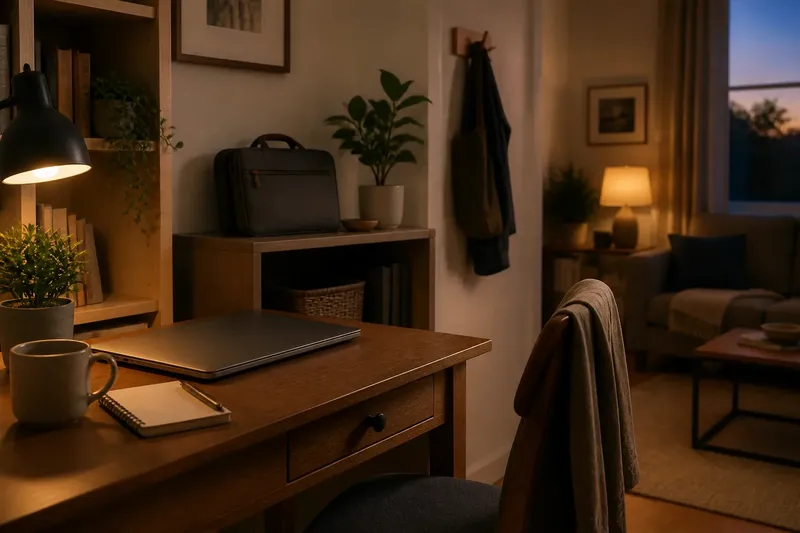
The common mistake with an end-of-workday ritual is making it so elaborate that it becomes another task to finish. A short, repeatable gesture can mark the end of a workday without demanding a perfect schedule or a special setting. Put the notebook away, change your shirt or close the work bag: the action gives the day a visible boundary.
This boundary matters most when work and home occupy the same rooms, or when a job’s demands linger after the computer is shut. A small ritual is not a promise that every work thought will disappear. It is a practical cue: this part of the day has ended, and the next one can begin.
1. Choose one gesture that clearly changes the scene
A useful ritual has an observable before and after. Your laptop is open; then it is closed and put away. You are wearing work clothes; then you have changed into something you associate with rest. The physical difference helps distinguish the workday from the evening more clearly than a vague intention to “switch off”.
Start with something already within reach. You might return your headphones to a drawer, hang an apron beside the kitchen, or put a paper diary on a shelf. Choose an action that feels like a natural stopping point rather than one that requires extra preparation.
Say you work at a small desk in the living room. You could close the laptop, slide it into its sleeve and place it on a shelf before moving the chair back. The expected observable result is a cleared work surface and a visible cue that the desk is no longer in use. The gesture does not need to make you feel calm on demand; it simply marks the change.
Pick one action to begin. A ritual can grow later, but it does not need a sequence to count.
2. Why do small rituals mark the end of a workday?
How does a repeated gesture create a boundary?
Repetition makes an action familiar, so it can serve as a cue for the transition. Putting work materials away each evening gives the same ordinary movement a clear role: the workday is finished for now.
What if work and home share the same room?
Use a change that is easy to see, such as placing a laptop in a closed bag or covering a work surface with a cloth. A boundary need not depend on having a separate office.
Does the ritual need to feel relaxing?
No. Its first job is to mark a change, not to produce a particular mood. A neutral action can still become a useful evening cue through repetition.
What if an urgent task interrupts the routine?
Use a smaller version, such as closing the notebook and naming the next task you will return to. That keeps the boundary practical without pretending the work is complete.
3. Make the action fit the shape of your work
Different jobs leave different traces. Someone who handles paper may need to stack documents in a tray; someone who works on a screen may need a clear way to close the session and put devices aside. A person who works from home may also need to reset the room, while a commuter may mark the transition by putting away an access card and changing out of work shoes.
Match the gesture to the thing that keeps pulling your attention back. If unfinished notes are the problem, leave one brief note for the next work session, then close the notebook. If visible equipment makes the room feel like an office, store it in a bag or cupboard. If work messages are the sticking point, the ritual might include placing the work phone in its usual spot away from where you spend the evening.
Keep any handover note concise and factual: what remains, and where to resume. Avoid turning it into a second round of planning. The purpose is to leave a usable marker for later, not to keep the evening mentally attached to the task.
For shift workers or people with changing schedules, use the end of the work period rather than a fixed clock time as the cue. The same gesture can happen in the morning or late at night; its meaning comes from its place in your routine.
4. Keep the ritual short enough to repeat
A ritual that depends on several conditions is easy to abandon. It might require a particular playlist, a freshly cleared room and time for a long walk. Those additions can be pleasant, but they are optional. The core gesture should still work when the day has run late or the room is untidy.
Try this simple test: can you perform the action on an ordinary, busy evening without rearranging the rest of your life? If not, shorten it. Instead of tidying the whole desk, put away the work papers. Instead of changing an entire outfit, take off the work jacket or shoes. Instead of creating a special beverage, rinse the mug and leave it by the sink.
- Choose a visible action: close, hang, fold, place or put away something connected to work.
- Give it a consistent cue: finish the last work task, sign out, or leave the work area.
- Keep the materials nearby: use the drawer, hook, tray or bag you already have.
- Leave room for variation: use a shorter version when the evening is crowded.
- Notice whether it helps: ask whether the action makes the boundary easier to recognise, rather than whether it creates a perfect mood.
The point is not to perform the ritual correctly. It is to make the transition easy to repeat.
5. Let the gesture mark a beginning as well as an ending
Putting work away can make space for the next activity without deciding what the entire evening must contain. After closing the laptop, you might set out a book, take a shower or simply sit down. The ritual closes one chapter; it does not have to prescribe the next one.
This distinction helps prevent a workday ritual from becoming a productivity scheme for leisure. You do not need to replace work with an equally organised list of evening accomplishments. A quiet interval, a conversation or an unplanned hour can follow the same small cue.
Some people prefer a sensory change: washing their hands, opening a window briefly or switching on a lamp. Others prefer handling an object, such as putting a key on its hook or folding a work apron. Choose the cue that suits the space and the task. A gesture is useful because it is recognisable to you, not because it looks ceremonial.
If another person shares the household, a simple spoken phrase can make the change legible without turning it into a formal announcement. “I’ve put work away” tells others what has changed and can help establish when you are available for ordinary evening conversation.
6. What should you change if the ritual stops working?
If the action becomes easy to skip, it may be too complicated or poorly placed. Move the storage spot closer to where you finish work, or choose a gesture that can happen at the natural end of your last task. If it feels meaningless, connect it to the part of work that most often spills into evening: the screen, the paperwork, the uniform or the repeated checking of messages.
There is no need to judge a ritual by whether it works every day. An interrupted evening does not erase the habit. Resume it when you can, or use the smallest version available. Over time, the same action may acquire a steady association with the end of work, while still leaving room for unusual days.
Think of the threshold hour as a hinge rather than a wall. A small ritual that marks the end of a workday can make the shift easier to notice, even when responsibilities continue in another form. Choose one concrete action, give it a familiar place in your routine, and let the rest of the evening remain open.